
Jamf Threat Labs discovers apps that leak credentials
Two mobile apps available for download are leaking personally identifiable information. Jamf Threat Labs investigates.
Author: Michal Rajčan
During Jamf Threat Labs continuous threat investigation we came across two apps leaking credentials and Personally Identifiable Information (PII). One is from a Malaysian healthcare management platform and the other is from an Indian jewelry company. In this blog, we take a deeper dive into the apps and the data they are leaking.
For both apps discussed below, we contacted the developer with a responsible disclosure to fix the mentioned leaks but have not received a reply. As part of our standard research process, we are releasing these findings publicly as the responsible disclosure timeframe has ended.
The risk of leaky apps
These apps leak data over unencrypted HTTP requests while users are trying to log in to their accounts. This means that requests with credentials in clear form (not obfuscated) are sent to the organizations’ servers unencrypted, exposing these data to all devices connected to the same network. This is especially risky in cases of users connecting to public networks.
Calm Radio
In late 2025, Jamf Threat Lab’s continuous monitoring and risk assessment triggered a credential leak alert related to the iOS app version. The developer promptly fixed the issue after our Responsible Disclosure with version 14.6.0 of the app.
Note: The Android app version was not affected by this issue.
During our investigation, we confirmed that the leak happened while users were trying to access paid content. Specifically, observing user emails being leaked in plaintext, but instead of a password, the app sent an access token. This token, according to the app developers, has no tie to user passwords.
Unfortunately, even without a leaked password, an adversary can obtain access to the premium stream or use leaked tokens to craft a new request that grants access to stored Personally Identifiable Information (PII). They cannot obtain access to the account thanks to the Calm Radio app login workflow.
Because inputting PII is voluntary and not required, the consequences of a potential account compromise may range from minimal to an invasive exfiltration due to the access token leak.
In connection to the credential leak, we observed two additional leaks:
- Any request to the affected domain was unencrypted: Though data is open to capture, the potential for tampering is low, so consequences pose no significant threat.
- Unencrypted call leaking session cookies: This occurrs while anonymous users make language preference requests. Anonymous users are guest users without previous login or account creation. It poses no real threat to subscribers, as they’ve already selected language preferences and anonymous users do not provide any data to leak.
In our Responsible Disclosure, we raised our findings to the developers, and the issues were remedied promptly. We would like to thank and emphasize the developer’s willingness, timeliness and communication in resolving the issues we found.
Khazana Jewellery
Khazana Jewellery's app serves as a “savings” management app for purchasable goods from Khazana Jewellery. Users can send monthly payments to Khazana Jewellery, and after the purchase scheme completion, they can purchase jewelry or gold in value from the scheme savings.
Jamf Threat Labs found the iOS version of the app is leaking credentials. However, the Android version of the app is safe from this issue.
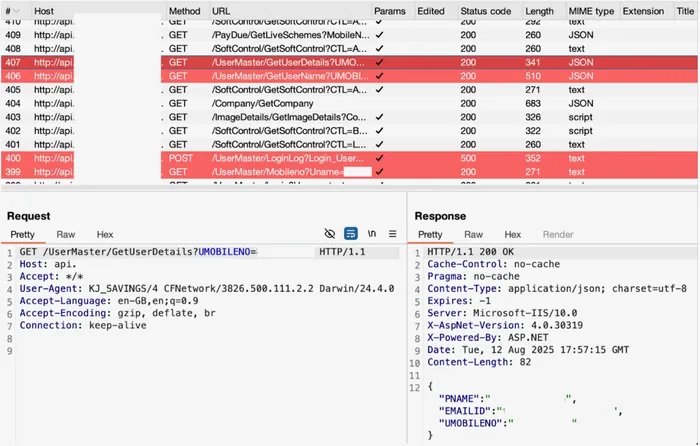
Example of a request leaking user credentials
There are several requests leaking data, and the following data is being leaked while users interact with the app:
-
User email
-
Password
-
Full name
-
Phone number
The app manages user payments and subscriber plans. If an attacker gets possession of the leaked credentials, they may log in to a compromised account and adjust it to their needs. This includes cancelling running subscriptions and causing unnecessary monetary harm in the form of cancellation fees.
The main risk of exposed credentials is access to the PII data stored in the app. When subscribing to a plan, a user needs to fill in personal details, and this data may be misused for an advanced phishing attack or identity theft on the user.
Extent of PII requested and stored in the app:
-
Full name
-
Phone number
-
Address
-
PAN number
-
ID number
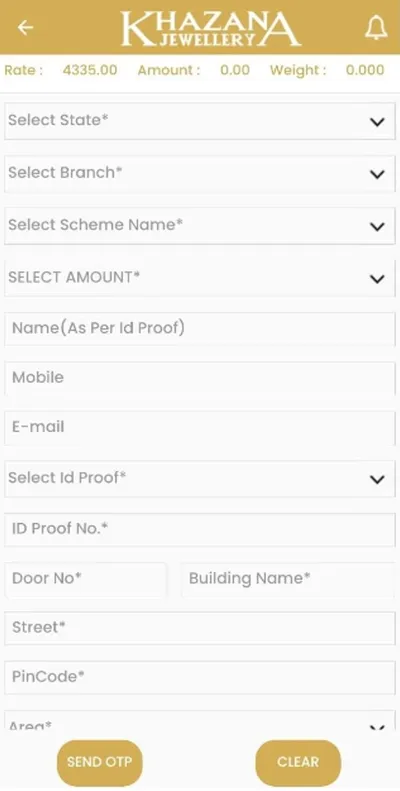
Example of personal data contained in app. Source: Google Play store
MiCare HealthTech Holdings
The healthcare management company serves 15 million users, hence we believe that the potential vector for misuse is not trivial.
Even though the leaky app is of low popularity and potentially kept for legacy reasons, the app remains in Apple and Android app stores and poses a real risk for users installing them.
The affected app is HBC-MED; iOS and Android versions show the same issues. This app appears to be a legacy management app and has been replaced by another app from the same developer.
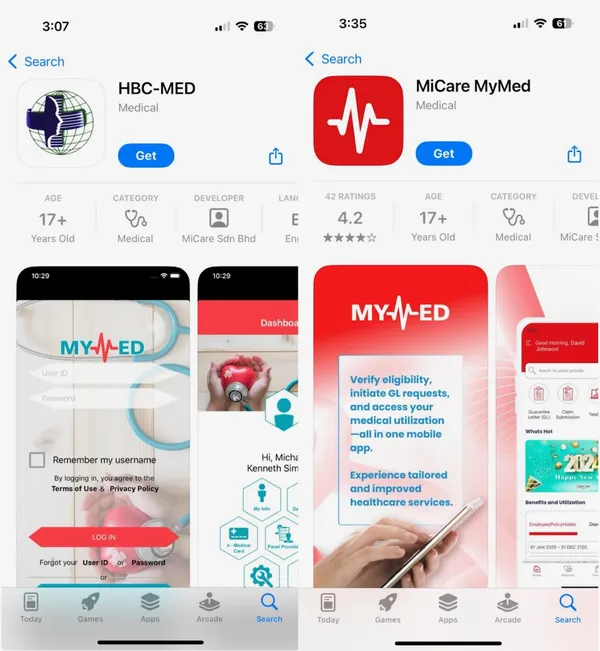
Left: Old app that leaks data | Right: New app that does not leak user data
We want to emphasize that the new app is not affected by the same flaws as the legacy one.
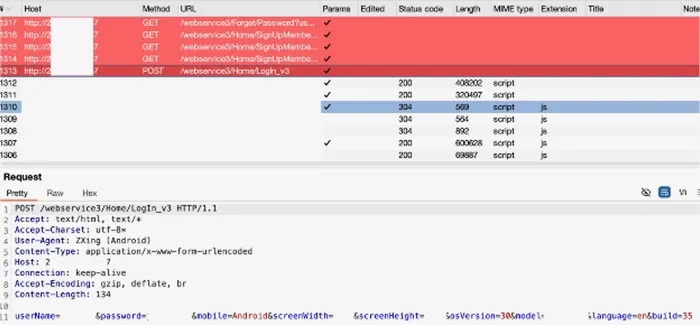
Example of a request leaking user credentials
There are several requests leaking data, and the following data is being leaked while interacting with the app:
-
Username
-
Password
-
National ID
-
Subscribed insurance/healthcare policy
-
Device HW specification (Android app only)
This credentials leak comes with another possibility of misuse. Given the nature of the leaky app, it is meant to manage users’ healthcare information. As clearly seen from the screenshot publicly shared in the app stores, the app has access to user personal data, medical card data and any dependent’s data. We could not confirm the extent of this data as we do not have any kind of working account for this healthcare management company. It is possible that this app has access to sensitive personal and healthcare data due to the nature of its purpose.
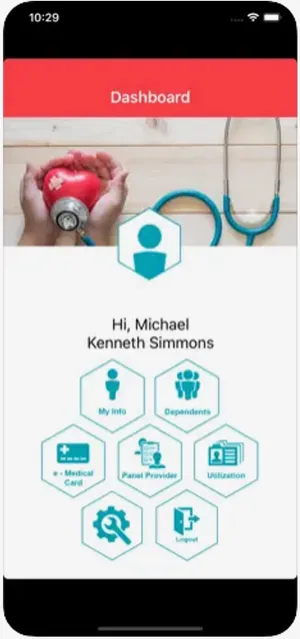
App’s interface showing access to data. Source: App Store for iPhone
Even though the affected users are very limited in number, we believe this type of private data exposure is critical and deserves attention.
Defend against data leaks with Jamf
Jamf for Mobile helps you protect your devices from leaky apps:
- Zero Trust Network Access (ZTNA) ensures only trusted users on managed device can access work apps and data.
- Continuously monitoring app risk levels and network traffic controls helps prevent specific apps from transmitting data entirely.
- Leveraging Apple’s On-Device Content Filtering allows you to block all network traffic from specific applications identified as data leakage risks.
Dive into Jamf Threat Labs research on our blog.