
What a lower-cost MacBook Neo means for education
Apple's new MacBook Neo brings Mac's creative power to more classrooms with education-friendly pricing that makes advanced learning experiences accessible to budget-conscious schools. Learn more.

Today, Apple announced the MacBook Neo, a new Mac designed to make the Mac platform more accessible to schools and students. Education pricing starts significantly lower than with previous MacBook models, making it easier for schools to bring the power of Mac to more learners and classrooms.
The MacBook Neo introduces a streamlined design aimed at education environments, featuring:
-
A compact display designed for portability in student backpacks
-
Two USB-C ports for charging, peripherals and classroom accessories
-
A 3.5 mm headphone jack, still essential for many classroom audio workflows
-
The familiar Mac keyboard and trackpad experience
-
The performance and reliability expected from the Mac platform
These components keep the design simple, while still maintaining reliability, flexibility and compatibility with learning. While the MacBook Neo is offered at a lower price point than previous Mac models, schools can still rely on high performance devices that empowers learners.
This performance matters. In a market where device decisions are often driven by cost comparisons, a lower-cost Mac will inevitably be compared to other education devices. Schools have to balance the cost of devices with their capabilities. Devices have to meet budget requirements and address a key concern:
What learning experiences does my device enable?
The MacBook Neo isn’t just about introducing a more affordable laptop into the market. It represents an opportunity for more students to access the powerful tools and creative workflows that have long defined the Mac experience in education.
Mac expands what students can create
Many classroom devices today are built primarily for accessing information.
Mac has always been about creativity.
Students use Mac to:
-
Produce podcasts and music
-
Edit video and digital media
-
Develop apps and learn programming
-
Conduct advanced research and analysis
-
Collaborate on creative projects
These are not niche activities anymore. They are increasingly central to modern teaching and learning, particularly in middle school, high school and higher education environments where students begin producing more sophisticated work.
Making Mac more accessible simply means more students can participate in these experiences.
Supporting the full Apple learning ecosystem
One of the unique advantages of Apple in education is the ecosystem of tools and devices that work together.
Schools often build learning environments that evolve with students:
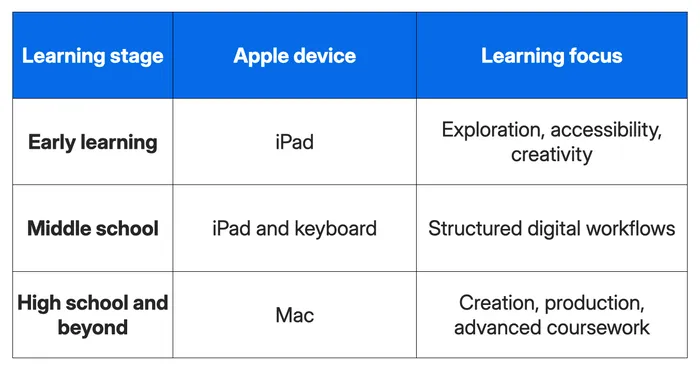
A more accessible Mac makes it easier for institutions to extend these workflows into later stages of learning without changing platforms or tools students already understand.
Instead of switching ecosystems, schools can simply expand what students are able to do.
Technology should support learning, not distract from it.
Access to powerful technology also comes with responsibility.
Schools today are balancing the benefits of digital learning with the need to ensure technology is used purposefully and safely.
That means ensuring devices are:
-
Set up with the right tools for learning
-
Managed securely
-
Protected from distractions
-
Aligned with classroom workflows
Technology works best in education when it’s intentionally deployed to support teaching and learning — not simply placed in students’ hands.
Scaling Apple deployments in education
As more students gain access to Mac and other Apple devices, schools also need a way to deploy, manage and secure them efficiently.
Education IT teams are already stretched. They need solutions that allow them to:
-
Automate device deployment
-
Simplify login and identity access
-
Maintain security and privacy
-
Support classrooms at scale
When devices are deployed with their purpose in mind, educators can focus on teaching while students focus on learning.
Expanding access to meaningful learning experiences
Affordable devices can help schools reach more students, but the real value comes from what those devices allow students to do.
For many schools, Mac represents an opportunity to move beyond basic device access and toward powerful, creative and future-ready learning experiences.
Expanding access to Mac simply means expanding access to those opportunities.
And that’s a conversation worth having.
Subscribe to the Jamf Blog
Have market trends, Apple updates and Jamf news delivered directly to your inbox.
To learn more about how we collect, use, disclose, transfer, and store your information, please visit our Privacy Policy.