
Privacy by default, flexible when required: introducing limited privacy in Jamf Safe Internet
Online safety is foundational. See how Jamf offers online safety with flexible controls, enabling districts to safeguard students while customizing protections to meet growing needs.
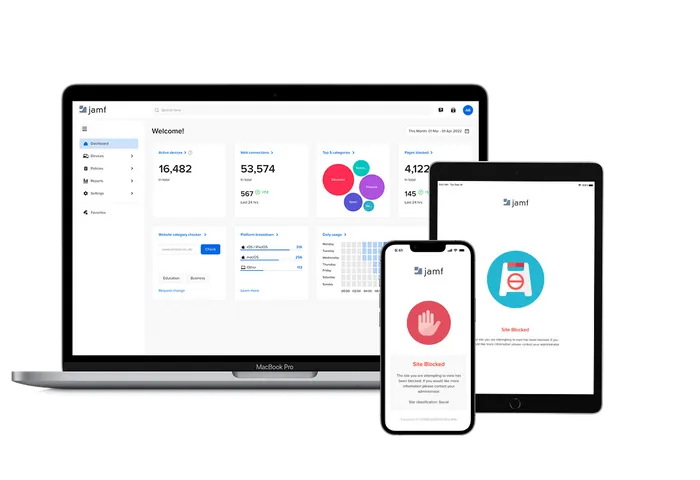
From inappropriate content and malicious code to risky behaviors and distracting websites, schools today are navigating a reality where learning happens everywhere — and so do online threats. Protecting students isn’t just an IT responsibility. It’s a shared priority across educators, school leaders, safeguarding teams and communities.
At Jamf, we believe that online safety and student privacy must go hand in hand.
That’s why Jamf Safe Internet has always been built with a clear principle: privacy by default.
But we also know that education systems around the world operate under different regulations and, in some regions, schools are required to take additional steps to meet legal compliance requirements.
To better support our customers, we’re introducing a new capability in Jamf Safe Internet: limited privacy.
Jamf Safe Internet has always been privacy-first
Jamf Safe Internet is designed to help schools keep students safe online while ensuring the student experience remains protected and appropriate.
That includes a commitment to privacy that reflects the values of education itself.
Students should be able to:
- Learn
- Explore
- Grow
In a digital world, without feeling like they are constantly being monitored.
Privacy is not a feature we switch on; it’s a foundation
That’s why Jamf Safe Internet is built to reduce risk while limiting exposure of individual student activity.
What is limited privacy in Jamf Safe Internet?
Limited privacy is an optional configuration setting that allows administrators to adjust privacy controls within Jamf Safe Internet to reveal individual user activity data.
It enables schools to access information that may be required under specific policy, compliance or regulatory frameworks.
Why we built limited privacy
In some countries and regions, regulatory requirements or government policies mandate that schools have granular access to user-level activity data, including an individual’s search history and browsing data.
For schools operating under these rules, the challenge becomes clear: they must meet compliance obligations, even when doing so may conflict with the privacy-first approach many institutions prefer.
Limited privacy supports customers’ unique needs
Designed with flexibility in mind, limited privacy is disabled by default.
It may be enabled in situations where schools must meet specific local requirements without requiring that it be the standard configuration for all environments.
Built with responsibility in mind
As this is a significant change in how student activity data is handled, limited privacy includes safeguards designed to ensure customers fully understand the impact of enabling it.
When enabling limited privacy, administrators are presented with clear messaging that explains:
- What this setting changes
- What data becomes visible
- What the privacy implications are
- Why this decision should not be taken lightly
A deliberate decision = a deliberate process
Enabling limited privacy requires a full redeployment of Jamf Safe Internet across devices (unless you have already switched to balanced privacy).
Rather than an inconvenience, this is a design choice.
It ensures customers treat this as a considered, intentional decision aligned to governance, compliance and safeguard policies rather than a quick configuration toggle.
Supporting student safety in all environments
Student online safety is one of the most critical responsibilities educational institutions face today.
But keeping students safe does not mean defaulting to surveillance.
At Jamf, we believe education technology should support student well-being, protect privacy and enable safe learning environments. All while respecting the role schools play in shaping trust, independence and responsible digital citizenship.
Limited privacy is our way of supporting customers who face different regulatory realities.
Privacy by default, granularity by choice
Jamf Safe Internet continues to deliver the same privacy-first protections our customers expect, while providing flexibility to markets where access to individual user activity is required.
Limited privacy is built for institutions that need it — and only for those who choose to enable it.
If you’d like to understand everything about limited privacy works before enabling it, contact your Jamf representative or explore the latest Jamf Safe Internet documentation.