
Platform State of the Union: JNUC 2026
Learn about the new upcoming Jamf platform features announced at the JNUC 2026 Platform State of the Union.
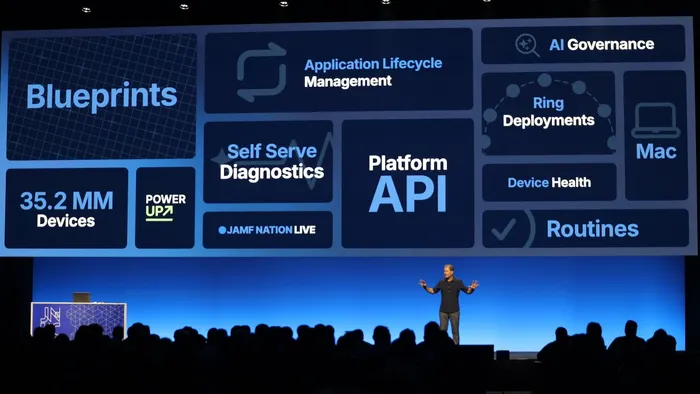
Sam Johnson, Chief Customer Officer at Jamf, begins by emphasizing his excitement for the future of Apple in the enterprise and how Jamf’s mission to “help you succeed with Apple is about to be redefined.”
What Jamf announced at the 2026 Platform State of the Union:
- Blueprints: site-scoped views, activations that change configurations based on triggers, device-level deployment reporting and full audit history
- Platform API Gateway and Platform API: all Jamf APIs behind a single authentication model and endpoint, with credentials managed centrally in Jamf Account
- Jamf Platform Terraform Provider: manage a Jamf instance as code — already in production at Lloyds Banking Group
- Routines: on-device logic checks that detect drift and remediate automatically, without waiting for a check-in
- App Insights: per-app risk scoring across outdated versions, potential data leakage and side-loaded code
- Jamf Device Checker: a new end-user app for frontline and shared-device teams that shows whether a device is ready to go and walks users through fixing it if not
- Jamf Tap: check out a device or log in with a physical access card or iPhone, with admins defining the conditions
He continues by reminding us about the JNUC keynote contents, including the Jamf platform, blueprints, APIs, autonomous endpoint management and AI governance. Each of these relies on cloud infrastructure and Single Sign-On (SSO) in Jamf Account as their foundation. To break this down, Molly Moseley, Principal, Product Transformation at Jamf, enters the stage.
Blueprints
Admins want to use blueprints at their own scale, structure, reporting and audit requirements — so we’ve ensured blueprints can get the job done. Moseley lists the admin-provided pain points Jamf has worked this past year to resolve and explains why updating blueprints is crucial for AI Assistant, compliance benchmarks, AI governance and more.

Molly Moseley, Principal, Product Transformation, talks about blueprints.
To illustrate what this progress looks like, Luke Allen, Senior Consulting Engineer at Jamf, joins Moseley for a live blueprints demo. This demo includes:
- Changing how admins view blueprints: by a specific site and a toggle between list or tile view
- Activations: configurations within a single blueprint change based on a specific trigger (like a user’s role or device’s operating system)
- Device-level reporting: tell at the device level if the blueprint is in scope, deployed, pending, failed or error — also accessible via the AI Assistant
- Audit history: know a device’s status, why changes were applied and who is accountable for the change
Platform API Gateway and Platform API
Moseley reminds us of Katie English’s words during the keynote: “For years, Jamf has been the platform you configure, but now it’s the platform you build on.” Many organizations use multiple Jamf products, and therefore multiple APIs to build their solutions — like the blueprint just demoed. With the recent introduction of the Platform API Gateway and platform APIs, APIs are consolidated into “a single authentication model, a single endpoint, with credentials managed centrally in Jamf Account” and covering all Jamf products.
Allen shows us what this means for admins in another live demo.
This demo goes through:
- How to integrate APIs from your Jamf Account and create API keys
- Creating compliance benchmarks programmatically with Platform API
- How to use the Platform API Gateway with the Classic API
Admins can also manage their Jamf instance via code with the Jamf Platform Terraform Provider. In fact, organizations are already doing so; like Lloyds Banking Group, who’s “retraining sysadmins to think like software engineers.” Moseley concludes by playing us a video from Lloyds Banking Group.
Fireside chat with Lloyds Banking Group
Sam Johnson returns to the stage, accompanied by Lloyds Banking Group’s Dafydd Watkins, Joseph Little and Gordon Deacon.

Sam Johnson talks to Lloyds Banking Group's Dafydd Watkins, Joseph Little and Gordon Deacon.
The Lloyds Banking Group team talks about how they managed their thousands of devices with Terraform, why they shifted to infrastructure as code and about their open-source Jamf Terraform provider.
Johnson ends the chat by shifting our focus from Mac management to mobile.
Power up with mobile devices
Tim Knox, Senior Consulting Engineer, enters the spotlight to talk about mobile devices enrolled in a Bring-Your-Own-Device (BYOD) program. Many employees use mobile devices daily on the job, and many don’t want to have a separate work phone. Jamf supports employee choice programs by separating work and personal data, making sure that “work stays contained, with controls that stop it from leaking into personal spaces,” Knox says. This way, personal data stays private and corporate data stays secure.
Routines
Since mobile devices aren’t always on your corporate network, Knox suggests an on-device predicate, where “a logic check the device runs itself, without needing to check in” first. This way, the device stays compliant on its own.
If something changes on a device, Routines react when needed. Knox asks Josh Sepos, Consulting Engineer Manager, to demonstrate.
The demo shows us how Routines responds to a device that falls out of compliance by notifying the admin and automatically remediating the problem.
App Insights
“However,” Knox continues, “a lot of risks live the apps themselves… and apps can be difficult to assess.” You might approve the app and trust the vendor, but what actually happens inside the app may be different from what you expect. Sepos’s demos App Insights, which gives risk insights for every app in your deployment, scored by:
- Outdated versions
- Potential data leakage
- Side-loaded code
Jamf Device Checker
Next, Knox and Sepos demo Jamf Device Checker, a new end-user app built for frontline and shared-device environments. This is great for rushed teams on the move, as it “tells someone at a glance whether their device is ready to go, and if it isn’t, walks them through fixing it,” Knox says.
Jamf Tap
The next demo exhibits Jamf Tap, which allows employees to use a physical access card or iPhone to check out a device, for example. Admins define the conditions, like what device a user should receive. Users can use tap to log into their accounts as well.
Power up your devices with Jamf
Devices need to work for both admins and users, which requires flexible, secure and powerful management behind them. Johnson returns to the stage and reminds us that over the last year, Jamf took admin feedback to improve:
- The flexibility and capability of blueprints
- Sites and activations so devices proactively stay compliant
- Device-level reporting and audit trails
- Hosting on your own terms
- The Platform API Gateway and infrastructure as code
Johnson promotes upcoming breakouts interactive lab and Braindates as excellent opportunities to dig deeper and get valuable information. “Absorb it,” Johnson concludes. “That’s what JNUC's all about.”
Visit the Jamf blog for the latest JNUC updates!