


White Paper
Govern AI on Mac with confidence
Discover, enforce and prove governance of the AI tools your workforce uses. Available with Jamf for Mac and Jamf for Mac - Higher Education.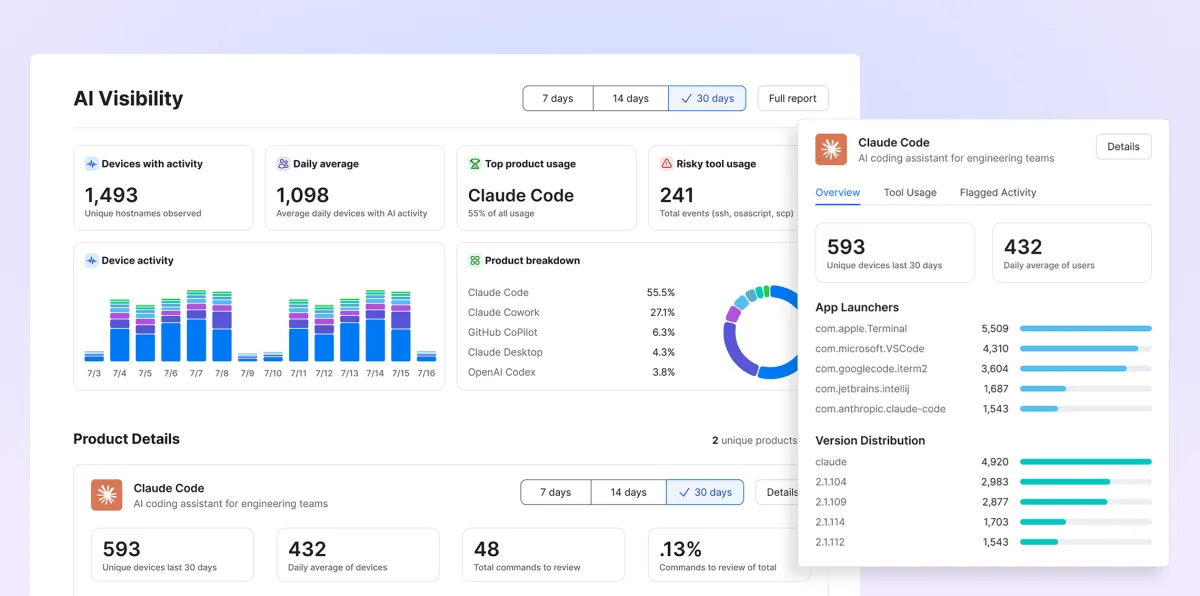
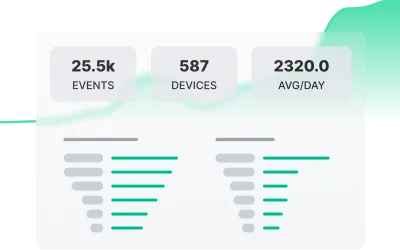
Shadow AI is already inside your organization.
It arrived the moment your first employee downloaded an AI tool.Employees use generative AI tools such as Claude Code, Claude Cowork, Open AI Codex, Claude Desktop, Cursor, and GitHub Copilot on your Mac fleet: outside of your governance. Engineering teams face leaked code; employees upload sensitive data to unsanctioned tools.
And your existing security tools see none of this activity; CISOs can't audit or defend it. But blocking AI doesn’t eliminate risk. It just slows everyone down.
The answer is to govern AI, not block it.
Govern it alongside the experts
Jamf works directly with Anthropic and AWS, so the controls in the policy builder are validated by the people who built the tools and stay current as those tools evolve.
AWS
Through the AWS partnership, Jamf governs both Anthropic and OpenAI from a single management plane, no additional infrastructure or separate vendor integrations required. OpenAI models on Amazon Bedrock launched in limited preview on April 28, 2026.
Anthropic
Anthropic exposes the deepest enterprise control surface in the market. Jamf's direct engineering partnership means curated defaults are validated by the people who built Claude and policy stays current as Anthropic ships new controls.
The business case for governing AI on Mac
57% of employees
Use personal GenAI accounts for work
Gartner, 2025 "Top Trends in Cybersecurity for 2026" | Read summary
33% of employees
Upload sensitive data to unapproved tools
Gartner, 2025 "Top Cybersecurity Trends for 2026" | Read summary
Companies are 3.4 times more likely
To be effective in AI governance when they deploy dedicated solutions.
Companies will spend $492 million
On AI governance in 2026
Gartner, 2026 Market Guide for AI Governance Platforms | Read summary
Priority #1
Gartner named agentic AI oversight a top cybersecurity priority for 2026
Mandatory AI governance
EU AI Act’s transparency rules take effect — the first binding enterprise AI regulation
The state of AI governance in the Apple enterprise
Generative AI adoption is moving faster than the governance frameworks designed to manage it. We surveyed 687 IT and security leaders across the Apple enterprise to understand how organizations are navigating adoption, risk, and what comes next. Read the full research or get the highlights below.
Blog
Ready to govern AI on your fleet?
Learn more about AI governance for Mac.Frequently asked questions
What is shadow AI and why is it a security risk for enterprise Mac users?
Shadow AI refers to generative AI tools that employees use without IT approval, including tools like Claude Code, Claude Desktop, Cursor and Copilot. On Mac, these tools run natively on Apple Silicon outside of standard security controls. IT can't see how they're configured or what data they're accessing, which creates compliance exposure and IP risk.
How does Jamf help enterprises govern AI tools on Mac?
Jamf gives IT and security teams:
- Visibility into AI tools running across their Mac fleets
- Controls that enforce which tools are sanctioned
- Governance reports that prove compliance to auditors and the board
IT does all of this through the device management infrastructure organizations already use.
How is AI governance different from a Cloud Access Security Broker (CASB) or network security tool?
CASBs and network proxies work at the domain level. They can block known AI URLs, but they can't see how AI tools are configured or how they behave at runtime on devices. Jamf enforces AI governance at the OS level through device management native to Apple Silicon, where existing security tools have no visibility.
How can organizations meet EU AI Act compliance requirements for AI tools?
EU AI Act transparency and audit trail requirements take effect in August 2026. Jamf captures every policy decision, deployment and enforcement action in a full audit trail. This is exportable to SIEM and generates the Executive AI Posture Report, providing compliance teams with the documentation they need without manual reporting.
How do IT teams enforce an AI acceptable use policy across a Mac fleet?
Jamf deploys AI access policy controls through device management: the same workflow IT uses for any other policy. IT can scope policies by user or group. Enforcement is at the OS level, so developers can't override them. Policies automatically update when tools like Claude Code release new controls.
Do I need a separate license for AI Governance?
No. AI Governance comes built into Jamf for Mac and Jamf for Mac - Higher Education, so if you already have one of those, it's ready to enable.
Is AI Governance available for K-12 institutions?
No. AI Governance is only available in Jamf for Mac and Jamf for Mac - Higher Education. K-12 institutions don't have access to this capability today.