
MTE as a microscope
Read a deep technical exploration of ARM's Memory Tagging Extension, Apple's Memory Integrity Enforcement (MIE), and how hardware-assisted memory safety is reshaping kernel security and vulnerability research across modern ARM architectures.

By Nir Avraham and Hu Ke
Background
In recent months, a new type of signal has begun appearing in our analysis pipeline — kernel panics that we had never seen before. Not because they represent a new attack, but because Apple's Memory Integrity Enforcement (MIE) hardware is now surfacing bugs that previously left no trace whatsoever. One particular case caught our attention: a kernel panic caused by a race condition deep inside the iOS networking stack that, on any device without Memory Tagging Extension (MTE), would have been completely invisible. There’s no crash, no log and no evidence it ever happened.
That experience prompted us to write this post. We believe ARM’s MTE goes beyond a security mitigation, representing a paradigm shift in how we find and understand kernel vulnerabilities, and the research community needs to develop new frameworks for working with it.
TL;DR: ARM's Memory Tagging Extension, and Apple's implementation of it (MIE), can detect memory safety bugs at the hardware level before corruption occurs. This post explains how the technology works at a deep technical level, demonstrates how it catches race-condition-induced, use-after-free vulnerabilities that are invisible without it, and argues that MTE should be understood not just as a defense mechanism but as a powerful new research tool.
The promise of hardware memory tagging
Memory safety vulnerabilities like buffer overflows, use-after-free and type confusion, remain the single most exploited class of software bugs. They are the foundation of virtually every sophisticated exploit chain, from jailbreaks to nation-state spyware like Pegasus. Despite decades of software-only mitigations (ASLR, stack canaries, CFI), attackers continue to find ways around them. The fundamental problem is that software mitigations are, by nature, playing defense on the attacker’s terms.
ARM’s Memory Tagging Extension (MTE), first specified in 2019 as part of ARMv8.5-A, offers a fundamentally different approach: hardware-enforced memory safety. Rather than trying to detect exploitation after corruption has occurred, MTE tags every memory allocation with a secret and verifies that secret on every access at silicon speed, with no software overhead for the check itself.
In September 2025, Apple shipped Memory Integrity Enforcement (MIE) on the iPhone 17 lineup, built atop an enhanced version of MTE they co-developed with ARM. This new feature was the culmination of a five-year engineering effort spanning silicon, OS and framework teams. And in the months since, real-world data has begun to confirm something researchers long suspected: More than preventing exploitation, MTE reveals entire categories of bugs that were previously invisible.
This post is a deep technical exploration of how MTE works, what Apple built on top of it, and why memory tagging is becoming an indispensable tool not just for defense, but for vulnerability research itself.
MTE under the hood: how tags protect memory
The core mechanism
MTE exploits a feature of the ARM64 architecture called Top Byte Ignore (TBI). In a 64-bit virtual address, only the lower bits are used for actual address translation. The upper byte (bits 63:56) is ignored by the MMU, making it available for metadata. MTE uses four bits of this upper byte (bits 59:56) to store a tag value (a number from 0 to 15).
Separately, for every 16-byte aligned granule of physical memory, the hardware maintains a corresponding 4-bit tag in a dedicated Tag RAM — a sidecar memory structure that the CPU consults on every load and store operation.
The mechanism is conceptually simple: When the CPU executes a load or store, it extracts the tag from the pointer and compares it to the tag stored in Tag RAM for the target address. If they match, the access proceeds normally. If they don’t, the hardware raises a tag check fault.
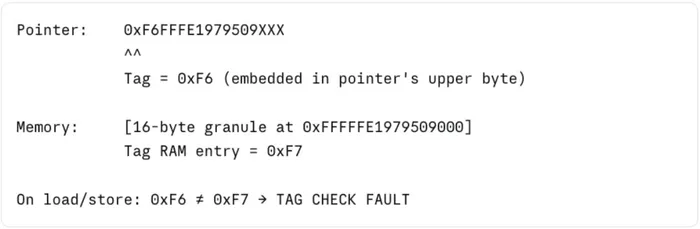
Tag lifecycle
Tags change at allocation boundaries. When kalloc() allocates a region, the allocator:
- Selects a random tag value (0–15) for the region
- Writes this tag to Tag RAM for all granules in the allocation, using the STG / ST2G instructions
- Returns a pointer with the tag embedded in the upper bits
When kfree() deallocates the region, the allocator writes a new, different tag to Tag RAM. Any dangling pointer still carrying the old tag will now mismatch, and the hardware will trap the access immediately.
Key insight:
With only 4 bits, there are 16 possible tag values. This means a random tag collision — where a stale pointer accidentally matches the new tag — has a 1/16 probability (6.25%). This is not cryptographic security. MTE is probabilistic, not deterministic. But for exploitation, even a 93.75% crash rate per attempt makes reliable exploitation extremely difficult, especially for complex multi-step exploit chains where each step must succeed.
For a three-step exploit chain where every step must hit a matching tag, the reliable-success rate drops to roughly (1/16)³ ≈ 0.024% — which is why MTE is so effective against full exploit chains even though the per-step odds look modest.
Synchronous vs. asynchronous checking
MTE supports two checking modes:
- Synchronous mode: The fault is raised immediately on the faulting instruction. The PC in the fault record points exactly to the offending load/store. Precise and invaluable for debugging but imposes a performance cost.
- Asynchronous mode: Tag check failures are logged but not immediately raised. Lower performance overhead but less useful for precise diagnosis.
Apple chose synchronous mode for MIE. Google’s Pixel implementation uses asynchronous mode for the kernel and a mixed approach in user space. This choice has significant implications for both security posture and research utility.
From MTE to MIE: Apple’s full-stack approach
To enable MTE on their chips, Apple re-architected the entire stack around it, creating a three-layer defense system they call Memory Integrity Enforcement.
Layer 1: Secure memory allocators
Even before MTE enters the picture, Apple’s zone allocator provides significant protection. The iOS kernel allocator organizes memory into type-specific buckets (“zones”), so that objects of different types and sizes are isolated from each other. When memory is freed, it is zeroed out and placed back in the appropriate zone. This makes heap spraying significantly harder.
This is the first line of defense and works on all devices, including older hardware without MTE support.
Layer 2: Enhanced MTE (EMTE)
Apple’s evaluation of the original MTE specification identified weaknesses that they considered unacceptable for real-time defensive deployment. Working with ARM, they co-developed Enhanced MTE (EMTE), also known as FEAT_MTE4 in ARM’s specification. Key improvements include:
- Canonical tag checking: In standard MTE, accessing non-tagged memory (such as global variables) from a tagged region is not checked. EMTE adds checking for these transitions.
- Enhanced fault reporting: All non-address bits are reported on a fault, giving the kernel more information for diagnosis.
- Store-only tag checking: An additional mode where only store operations are checked, useful for specific performance-sensitive contexts.
Layer 3: Tag Confidentiality Enforcement (TCE)
A critical weakness in any tag-based system is that if an attacker can learn the tag value, they can forge a matching pointer. Research such as the TikTag attack demonstrated that MTE tags could be leaked through speculative execution side channels. Apple developed Tag Confidentiality Enforcement to address this, including mitigations for Spectre V1-style attacks with “virtually zero CPU cost.”
Silicon-level optimization
The A19 chip was designed from the ground up with MTE workloads in mind. Apple modeled the exact tag-checking demand of the entire operating system and designed the silicon to satisfy it. Rather than accepting a performance penalty, Apple designed the hardware to eliminate it.
Deployment scope:
MIE is always on for the kernel and over 70 userland processes on A19 devices. Third-party applications can opt in via an Xcode entitlement. MIE is currently exclusive to the A19/A19 Pro (iPhone 17, iPhone 17 Pro, iPhone 17 Pro Max, iPhone Air). As of writing, it has not been announced for M-series Mac chips.
When tags catch a ghost: a race condition case study
To illustrate why MTE is so transformative for research, we'll walk through a real case we encountered: a kernel panic on an iPhone 17 Pro running iOS 26.4, produced by a race-condition-induced use-after-free in a kernel networking subsystem. For responsible disclosure reasons, we'll describe the shape of the bug rather than the exact code path.
The anatomy of the race
The affected subsystem manages per-process network policy objects. Like many kernel subsystems, it uses two different locks to protect different invariants:
- Lock A: A reader-writer lock protecting a global registry (a tree structure containing all active policy objects across all processes).
- Lock B: A per-object mutex protecting the individual policy object's internal state.
These two locks cannot be safely nested in either direction because different code paths take them in reverse order, which would cause deadlock. As a result, code that needs both locks must release the first before acquiring the second. This creates an unprotected window between the two lock holds — and that window is where the bug lives.
The vulnerable function
The affected kernel function performs what looks, at first glance, like a reasonable sequence:
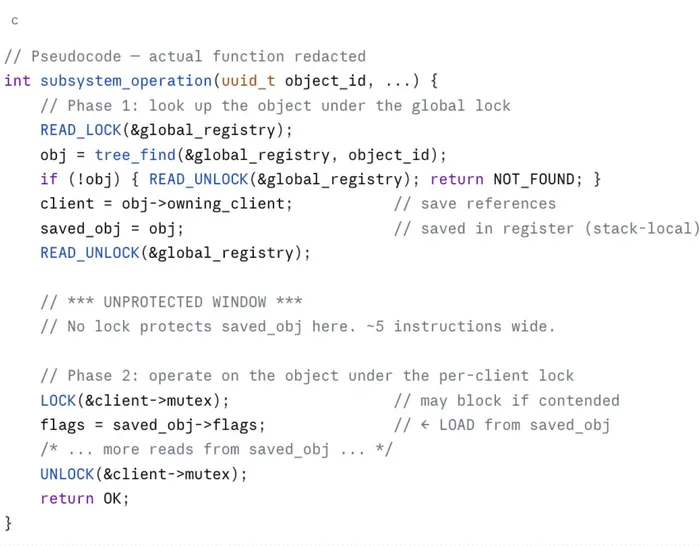
The pattern here is extremely common in kernel code: look up an object under a coarse-grained lock, release it, then fine-grained operations under the object's own lock. The implicit assumption is that the object cannot disappear between the two lock acquisitions.
This assumption is wrong if another thread is allowed to destroy the object during that window.
The destroyer path
Elsewhere in the same subsystem, cleanup code (triggered by a process closing a file descriptor or exiting) does the following:
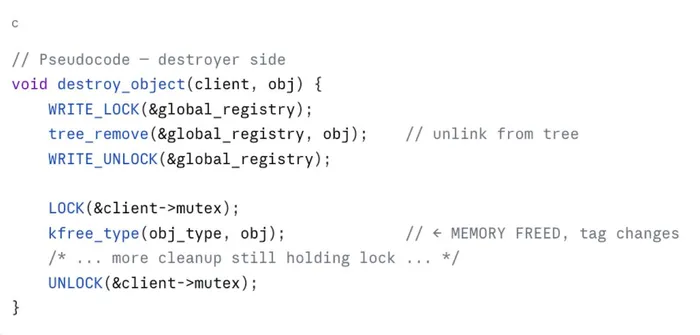
Note the critical detail: kfree happens while the per-client mutex is still held. This is important for both the bug and how MTE catches it.
The race interleaving
With both paths in mind, here's how the race fires:
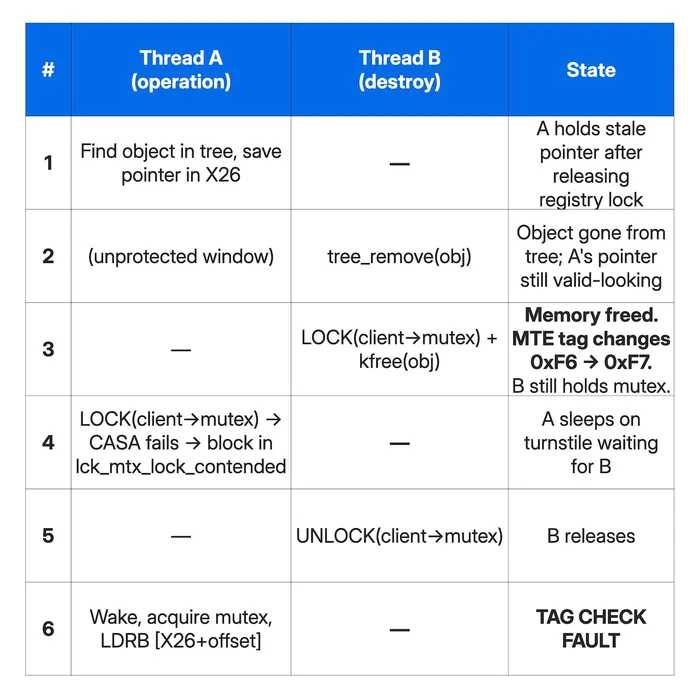
Crucially, this is a two-thread race — no third actor is required. The contention that makes Thread A take the slow-path blocking in lck_mtx_lock_contended is caused directly by Thread B, which is also the thread that frees the memory.
What the panic looks like
The kernel panic produced by this race has a distinctive signature. Here's a redacted view of the relevant parts:
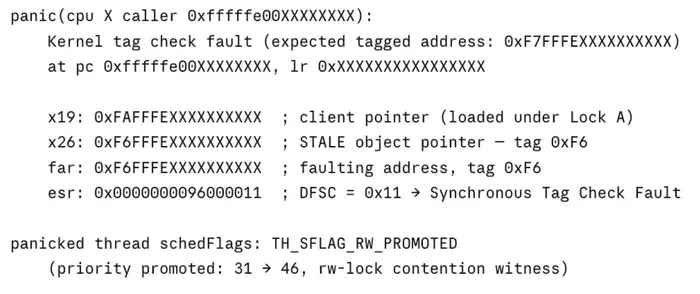
Four observations from this register state encode the entire story of the bug:
- The stale pointer in X26 carries tag 0xF6, the allocation-time tag.
- The "expected tagged address" from the panic message carries tag 0xF7, the post-free tag written to Tag RAM by kfree.
- The LR value (redacted above as lr 0xXXXXXXXXXXXXXXXX) decodes to the return address from lck_mtx_lock_contended, which only appears when the mutex acquisition took the slow path, i.e., it was contended when the thread first attempted CASA. This is direct hardware evidence that Thread A was blocked on the mutex at the moment Thread B was freeing the memory.
- TH_SFLAG_RW_PROMOTED on the panicking thread indicates it was priority-promoted due to reader-writer lock contention, the signature of Thread B taking WRITE_LOCK on the global registry while Thread A held READ_LOCK.
Taken together, these four signals reconstruct the race timeline from a single panic log. Every one of these signals is available only because MTE caught the fault synchronously on the exact instruction that dereferenced the stale pointer.
What this looks like without MTE
The exact same race, on a non-MTE device, produces an entirely different outcome:
- Thread A saves stale pointer, releases registry lock
- Thread B removes from tree, takes mutex, kfrees the object; zone allocator zeros the memory, releases mutex
- Thread A wakes, acquires mutex, dereferences stale pointer
- Thread A reads 0x00000000 at stale_obj->flags
- The if (flags & FLAG_X) check evaluates false
- Function returns cleanly with no crash, log or trace.
The bug still occurred and a freed object was dereferenced. But because the zone allocator zeroed the memory, and because the code path happened to tolerate a zero-valued read, the bug produced zero observable effect. According to a fuzzer, unit test and a kernel panic log, it never happened.
Reproducibility: the silent bug problem
We attempted to reproduce this race condition in a controlled environment. Our PoC creates the relevant kernel objects from a sandboxed app, triggers qualification from a content filter, and rapidly destroys the objects — precisely the pattern that produced the original panic.
On an MTE-enabled device, we expect this to panic eventually. On non-MTE devices (including virtualized research environments like Corellium that do not support MTE/MIE emulation), the race fires, but the fault is invisible:
- The zone allocator zeroes freed memory, so the stale dereference reads zero
- The zero-valued read happens to be tolerated by the code path
- Nothing crashes, nothing logs
This is a direct, practical demonstration of the "dark matter" concept. The bug has been executing somewhere between "occasionally" and "frequently" in production for an unknown length of time. But before MIE, there was no instrument sensitive enough to observe it.
The diagnostic framework: tag check fault vs. data abort
For vulnerability researchers analyzing kernel panics on MTE-enabled devices, the panic type itself becomes a first-order triage signal. This distinction creates a new analytical framework.
Reading the ESR (Exception Syndrome Register)
The ESR encodes the cause of the exception. For MTE-related faults:
What each tells you
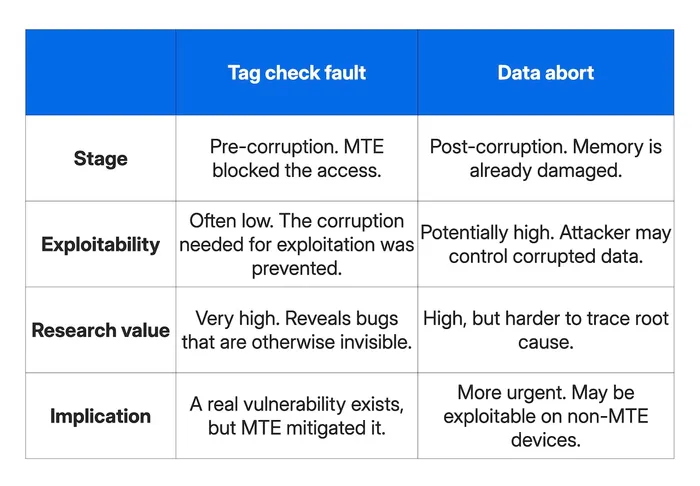
Tag reconstruction from panic logs
When analyzing a tag check fault, you can reconstruct the full story from the register state:
- Identify the stale pointer: Look at the register holding the object pointer. The upper nibble of the address is the stale tag.
- Identify the expected tag: The panic string itself reports the expected tagged address, which contains the current tag in Tag RAM.
- Confirm retagging: If the two tags differ by a small number, it’s consistent with sequential allocator retagging. If they appear random, the object was freed and the granule was reallocated entirely.
- Read scheduling flags: Flags like TH_SFLAG_RW_PROMOTED on the panicking thread are strong signals that concurrent lock activity (i.e., a second thread) was involved, a classic fingerprint of a race condition.
- Decode the LR: If the link register points to a known lock slow-path function (e.g., a _contended routine), it means the mutex was contended at the moment of fault — direct evidence of a concurrent lock holder.
- Locate the free(): Work backward from the faulting function to identify which code path freed the object and which retained a stale reference; this reveals the race condition.
MTE as a research tool: revealing the invisible
Historically, MTE has been framed as a defensive mitigation — a mechanism to make exploitation harder. But our research experience suggests an equally important role: MTE as a bug-finding tool.
The “dark matter” problem
Consider the class of bugs described in Section 4: race conditions that lead to use-after-free, where the zone allocator masks the symptoms. Without MTE, these bugs:
- Produce no crash
- Generate no log entry
- Leave no forensic trace
- Pass all existing test suites
- Survive years of production deployment
These are the “dark matter” of the kernel bug landscape. They exist and may even be numerous. With no mechanism to reveal them, they’re invisible to every traditional tool, including fuzzers, static analyzers, manual audits, and dynamic testing with sanitizers.
MTE changes this equation. By tagging every allocation and checking every access at hardware speed, MTE turns invisible bugs into visible faults. This happens continuously, in production and on every device.
Implications for vulnerability research methodology
1. New bug classes become discoverable. Race-window UAFs in kernel subsystems that handle high-frequency events (networking, filesystem I/O, IPC) may only trigger under specific timing conditions. Fuzzers may never reproduce the exact interleaving, but MTE will catch it the first time it happens on any real device.
2. Crash log analysis becomes a research tool. For organizations that analyze device crash logs at scale (OEMs, security vendors, MDM providers), MTE tag check faults represent a new signal channel. Each fault is evidence of a memory safety bug.
3. Exploitability assessment shifts. A bug that triggers a tag check fault on MTE hardware may still be exploitable on non-MTE devices, making it reportable and patchable even though MTE prevented the worst outcome. In other words, MTE-assisted triage provides a rapid way to discover bugs that affect the much larger installed base of non-MTE devices where the same bugs are potentially exploitable.
Research platform limitations
A practical consideration: not all research environments support MTE. For example, Corellium — widely used for iOS kernel research — does not currently support MTE/MIE emulation. This means:
- Bugs that only manifest as tag check faults cannot be reproduced on Corellium.
- The zone allocator still provides protection, so the UAF is masked even in the emulator.
- Researchers may need to manually inject corrupted pointers to force a fault for testing.
- Physical MTE-enabled devices become essential for comprehensive vulnerability validation.
The research paradigm shift
MTE inverts the traditional vulnerability research model. Instead of “find the bug, then determine if it’s exploitable,” MTE enables “observe the fault, then trace back to the bug.” The hardware is doing the hard part — detecting the illegal access — and the researcher’s job shifts to root-cause analysis and impact assessment.
Implications and looking forward
For defenders
MTE/MIE represents a genuine step change in device security. For the first time, a hardware mechanism provides always-on, zero-configuration protection against the two most common memory safety vulnerability classes. Organizations deploying MTE-enabled devices should instrument their crash log pipelines to flag tag check faults — each one is evidence of a real bug.
For attackers
MTE significantly raises the cost of exploitation. With a 1/16 probability of tag collision per attempt, multi-step exploit chains become exponentially less reliable. Combined with synchronous checking and Tag Confidentiality Enforcement, the attacker’s path narrows considerably.
However, MTE is not a complete solution. 4-bit tags provide limited entropy. Logical bugs, type confusions within the same zone, and info leaks that don’t involve memory corruption remain outside MTE’s scope. The race condition we described is a good example of the latter consideration: On MTE hardware, the bug crashes reliably; on the still-enormous installed base of non-MTE hardware, the same bug is both exploitable and invisible.
For the ecosystem
Apple’s MIE and Google’s Pixel MTE implementations represent two different philosophies applied to the same technology. Apple’s approach is more comprehensive (always-on, synchronous, with EMTE and TCE) but limited to the newest hardware. Google’s approach shipped earlier on more hardware but with less aggressive enforcement. For research specifically, the difference is substantial: Pixel's MTE is opt-in per-app (or gated behind Advanced Protection) and can run in async mode, where a tag mismatch yields a SIGSEGV at the next kernel entry without the faulting address recorded. Apple's MIE is always-on and synchronous across the kernel and 70+ userland processes, pinning every fault to the exact load/store. Apple's Tag Confidentiality Enforcement also closes the speculative side channels (e.g., TikTag) that can leak tags on Pixel hardware.
The real question is how quickly third-party app developers will opt in. MTE can expose latent memory safety bugs in any C/C++ code, which means some apps will crash when MTE is enabled — bugs that existed all along but were never visible. Every crash is a bug found and fixed.
Summary
MTE does more than mitigate potential threats. It acts like a microscope that reveals an entire class of bugs that the security community never had the tools to see. As MTE-enabled hardware proliferates, we expect the rate of discovered kernel vulnerabilities to increase temporarily, not because the software is getting worse, but because we can finally see what was always there.
The case we walked through — a race condition UAF in a high-traffic kernel subsystem, surfaced only because of MIE's synchronous tag checking — is very likely just one of many. Every iPhone 17 in the field is, in effect, running a continuous, silicon-speed memory-safety fuzzer against the iOS kernel. The bugs it finds have been there all along. Now that they can be detected, they can be fixed. The entire ecosystem benefits.
For those of us who spend our days reading panic logs, MTE has quietly changed the job. A tag check fault is a mitigation success. And now, it's a lead into new threats.
Stay informed with the latest research from Jamf Threat Labs.