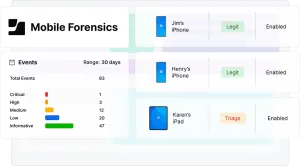
Mobile forensics, minutes not weeks: from suspicion to timeline
Jamf Mobile Forensics detects sophisticated mobile spyware in minutes — giving security teams a complete incident timeline without surrendering the device.
Introduction
When a traveling executive tells their security team that something feels off about their iPhone:
- Apps crashing
- Battery draining
- Running unusually slow
The clock starts ticking – not just on the threat itself, but the investigation.
At many organizations, investigations require surrendering devices for a full forensic examination.
What do mobile investigations entail?
- Weeks of waiting
- Specialized expertise
- Significant cost
And a highly visible employee without their most critical work tool.
Mobile threats increasingly targeting high-profile users
Since 2021, Apple has sent threat notifications to users in over 150 countries. The targets aren’t random. They’re chosen for who they are, what they do and the sensitive data their devices hold.
Never have mobile threats been more sophisticated or more deliberate. Going beyond the standard end-user, this segment specifically targets:
- Corporate executives
- Government officials
- Press journalists
- Political dissidents
Jamf Mobile Forensics was built for exactly this moment. And in this blog, we discuss how it quickly handles forensics to ensure mobile device security remains a top priority for high-risk users.
The scenario: when legacy security tools aren’t enough
Foundational security layers like mobile device management (MDM) and mobile threat defense (MTD) do their jobs well. They enforce policies, block known threats and keep devices compliant.
But they cannot access the deep system logs needed to detect sophisticated spyware like Pegasus, Predator or Graphite — the kind of mercenary-grade malware used in targeted nation-state attacks.
When a device shows signs of compromise, traditional forensic tools demand deep expertise to operate and interpret the results, which takes time as the investigation unfolds. During this time, the loaner phone program kicks in: a clunky workaround that:
- Creates shadow IT risk
- Adds operational overhead
- And frustrates inconvenienced users
From suspicion to timeline: a 22-minute walkthrough
Note: Depending on the inspection type initiated, times can vary. This includes faster or deeper inspections that take more time.
Imagine this scenario: a senior executive tells their security team their device is acting slow. However, with Jamf Mobile Forensics, here’s how the time unfolds in a faster, smarter, less frustrating way for security teams and the high-risk users they’re trying to protect.
N + 0:00: The executive flags the issue. No device surrender required.
N + 1:00: The security team runs a scan using the Mobile Forensics Connector over cable in the office, or the app's remote DFIR inspection if the executive is traveling. The Jamf Mobile Forensics app begins its investigation:
- Collecting OS logs
- Kernel panics
- Crashes
- Process data
- Installed applications
- Wi-Fi manager logs and more.
As the investigation runs, privacy is protected by design – not by policy. Sensitive, private information is never gathered, such as:
- Passwords
- Photos
- Messages
- Emails
- Contacts
- Call data
- Browser history
N + 15:00: The inspection surfaces results tied to applications, processes, selected file paths, profiles, certificates, crashes and kernel panics. Creating an iOS System Diagnostic is a manual step today, but provides a more robust analysis of the device.
N + 20:00: AI Analysis is engaged as an assistant to research device crashes and anomalies that don’t clearly signal an attack on their own. The results surface two high-severity events, with one matching a known indicator of compromise (IoC) associated with mercenary spyware and recommends next steps.
N + 22:00: After an incident is confirmed, remediation begins directly from the Mobile Forensics portal through integration with MDM to send remote commands. While the executive keeps their phone, the security team has gathered a complete event timeline, including:
- What happened
- When it happened
- Which IoCs were found
- What is the scope of the intrusion
No loaner phone and no waiting weeks for a specialized forensics team – just twenty-two minutes from initial alert to a complete timeline of events.
Speed is an actionable defense
That 22-minute window isn’t just impressive — it changes what’s possible for security teams protecting high-risk users.
Every minute an attack goes undetected is another minute of dwell time. By detecting mobile threats faster, the exposure window reduces. This translates to minimal disruption of high-value users within your organization and the tools they rely on to operate in their executive role.
For IT and security teams, it means actionable intelligence feeds directly into SOC workflows the minute incidents are resolved – not time-delayed report delivered three weeks after the fact.
Organizations using Jamf Mobile Forensics can run continuous background scans, building a forensic baseline so that when a threat does appear, the timeline already exists. Security teams can proactively scan devices anytime high-profile users return from a high-risk region, ahead of sensitive operational meetings, or as part of routine protection by generating:
- Evidence-grade findings
- Incident timelines built automatically
- Remediation that starts before the meeting room clears
Robust mobile protection for users who are targeted simply because of who they are, the work they do and the types of data they have access to.
Backed by Jamf Threat Labs
Every detection in Jamf Mobile Forensics is backed by Jamf Threat Labs – our team of security researchers, analysts and engineers who work in the field every day. Jamf Threat Labs drives continuous improvements to the Jamf Mobile Forensics detection engine and rule sets. Furthermore, the team’s research consistently uncovers nation-state attacks against mobile devices in real-world deployments.
The IoCs in Jamf’s console aren’t sourced from third-party threat feeds alone, they include active, ongoing research obtained from many deep dives, a few of which are:
- The internals of MobiDash adware
- DarkSword iOS exploit kit
- Kernel engine behind Predator spyware
When your security team looks at a finding in Jamf Mobile Forensics, they’re looking at intelligence built by people who study these attacks for a living.
Ready to move from suspicion to timeline in minutes?